






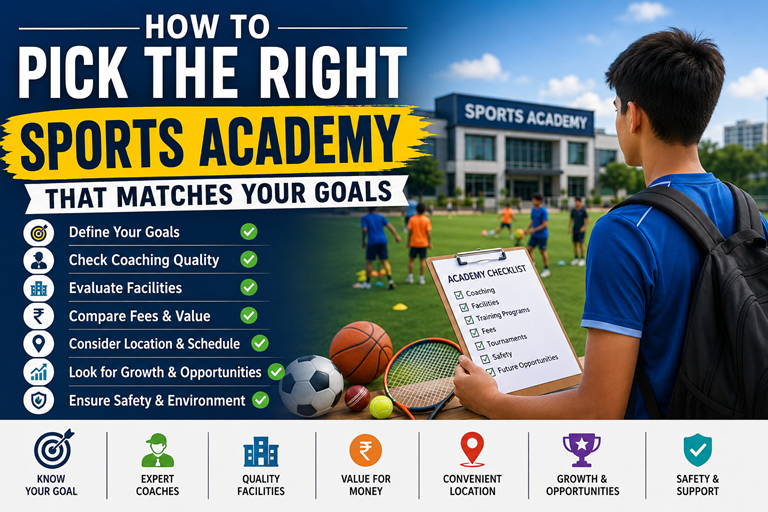
Choosing a sports academy can look simple from the outside. Search for an academy, check the ratings, compare the fees, and sign up. But that approach can lead to a frustrating experience if the academy is excellent at one thing while being completely wrong for your needs.
A beginner who wants to learn football recreationally does not need the same environment as a teenager preparing for state-level competition. An aspiring cricketer may care about net facilities and match exposure, while a swimmer may prioritize pool quality, coaching ratios, and competition schedules. The real question isn’t simply which academy is “best.” It is how to pick the right sports academy for your specific goals, ability, budget, and schedule.
Quick Summary: What to Check Before Joining a Sports Academy
- Define your primary goal: fitness, recreation, skill development, competition, or a professional pathway.
- Check the coaches’ qualifications, experience, and coaching approach.
- Visit the academy instead of relying only on photographs or online reviews.
- Evaluate training facilities, equipment, cleanliness, and safety.
- Compare fees with what is actually included in the program.
- Consider location, travel time, class schedules, and training frequency.
- Ask about player development, assessments, tournaments, and progression opportunities.
- Try a trial session when available before committing to a long-term package.
- Speak with current athletes or parents to understand the everyday experience.
1. Start With Your Sports Goal
Before comparing academies, take a step back and decide what you actually want from sports training.
This sounds obvious, but it is one of the most frequently overlooked parts of the decision. People often search for the “best sports academy near me” before deciding what they expect the academy to accomplish.
Your goal could be as straightforward as becoming more active. You might want structured exercise after school or work. Perhaps you are interested in learning a new sport socially. Or maybe you have a much more ambitious target: school competitions, district tournaments, state selection, national-level events, or a long-term professional career.
Those goals require different training environments.
Recreational and Fitness Goals
If your main objective is fitness and enjoyment, look for an academy that offers:
- Beginner-friendly coaching
- Flexible class schedules
- Reasonable training intensity
- Supportive coaches
- Clean and accessible facilities
- A positive group environment
You probably do not need an expensive elite-performance program if you simply want to play twice or three times a week.
Skill Development Goals
If you already understand the basics and want to become technically stronger, investigate how the academy structures its coaching.
Ask whether athletes receive individual feedback or simply participate in group drills. A good program should progressively challenge players rather than repeating the same exercises every session.
For example, a young footballer may need technical work with both feet, first-touch exercises, passing under pressure, tactical understanding, and game situations. A beginner-level program may focus primarily on basic movement and ball control.
Competitive or Professional Goals
Competition changes the equation.
If your ambition is to compete seriously, investigate whether the academy provides tournament exposure, performance assessments, strength and conditioning, sports psychology support, and opportunities to progress into higher-level teams.
Ask a direct question: Where have the academy’s athletes gone after completing its program?
Specific answers are far more useful than claims such as “we develop champions.”
2. How Important Is the Coaching Staff?
Facilities can attract you to an academy, but coaching quality usually has a much greater influence on the training experience.
A large ground, modern equipment and impressive branding cannot compensate for poor instruction.
Check the Coaches’ Background
Look for relevant qualifications, playing experience, coaching certifications, and experience working with athletes in your age or ability group.
Experience matters, but don’t assume that the most accomplished former player is automatically the best coach. Playing at a high level and teaching effectively are different skills.
A strong coach should be able to explain why an athlete needs to change a technique, demonstrate the correction, observe the athlete, and provide useful feedback.
Observe How Coaches Interact With Athletes
If possible, attend a session before enrolling.
Watch what happens when an athlete makes a mistake.
Does the coach explain the problem constructively? Does everyone receive attention? Are beginners ignored while advanced players receive most of the coaching?
These details tell you much more than a promotional brochure.
For children and teenagers, coaching personality is particularly important. A technically knowledgeable coach who constantly humiliates or intimidates players may create an environment that damages confidence and motivation.
3. Evaluate Facilities, Equipment and Training Environment
A sports academy doesn’t necessarily need the most expensive facilities in the city. It does, however, need facilities appropriate for the sport and level of training.
A cricket academy, for instance, should have suitable practice nets, quality pitches or bowling surfaces, appropriate equipment, and enough space for different drills. A swimming academy needs a properly maintained pool and appropriate safety procedures. A badminton academy needs usable courts, suitable lighting, adequate ventilation, and equipment that supports consistent training.
Look Beyond the Showcase Areas
When visiting, don’t just look at the newest equipment.
Check:
- Training surfaces
- Equipment condition
- Lighting
- Ventilation
- Changing areas
- Drinking-water availability
- First-aid arrangements
- Cleanliness
- Crowd levels
- Storage and equipment organization
- General maintenance
An academy can have excellent photographs online while everyday conditions tell a different story.
Is Safety Taken Seriously?
Safety should never be treated as a secondary feature.
Ask what happens if an athlete is injured during training. Is first aid available? Are coaches trained to respond to common sports injuries? Are training areas maintained regularly?
For younger athletes, also check supervision arrangements, entry and exit procedures, and whether the academy has clear policies for parents and guardians.
4. Does the Training Program Match Your Level?
Two athletes can join the same academy with completely different needs.
A beginner requires foundational instruction. An experienced athlete needs refinement, tactical development, physical conditioning, and competition-specific preparation.
The right sports academy should therefore have a clear progression system.
Ask How Athletes Are Assessed
A useful question is:
“How do you decide which training group an athlete belongs to?”
Some academies group athletes purely by age. Others consider age, ability, experience and performance.
Neither approach is automatically perfect. The key is whether the grouping helps athletes train effectively.
You should also ask how progress is measured.
Does the coach provide periodic feedback? Are skills assessed? Are athletes moved into more advanced groups when they improve?
A structured development pathway is a positive sign because it shows that training is designed around progression rather than simply attendance.
Match Training Frequency to Your Goal
Training once a week may be enough for someone playing casually. It may not be enough for an athlete preparing for serious competition.
Before enrolling, calculate how many sessions you can realistically attend.
There is little value in buying a six-day-per-week program if school, work, travel, or other responsibilities mean you can attend only twice.
Consistency usually matters more than an impressive schedule that you cannot maintain.
5. Compare Sports Academy Fees With the Value You Receive
Price is an important consideration, but the cheapest academy isn’t necessarily the best value.
Likewise, high fees don’t automatically indicate high-quality coaching.
Sports academy fees can vary significantly depending on the sport, city, facilities, coach experience, training frequency, competition exposure, and additional services.
Ask What the Fee Includes
Before paying, clarify whether the advertised fee covers:
- Registration
- Coaching sessions
- Equipment
- Uniform or kit
- Tournament participation
- Match fees
- Fitness or conditioning sessions
- Facility access outside regular classes
- Assessment or evaluation
- Transportation
- Membership charges
An academy with a slightly higher headline price could actually be more affordable if it includes services that another academy charges separately.
Watch for Long-Term Commitments
Be cautious about signing a lengthy contract immediately.
If possible, start with a trial class, short-term package, or monthly membership. This gives you time to judge the coaching environment before making a larger financial commitment.
A good academy should be confident enough in its program to let prospective athletes experience it before committing.
6. Is the Location Convenient Enough?
Location is one of those practical factors that people underestimate.
An academy may have outstanding coaches, but if getting there takes 90 minutes each way, maintaining a regular training routine could become difficult.
Think about the entire journey, not just the distance shown on a map.
Consider:
- Travel time during peak hours
- Transportation options
- Parking
- School or work schedules
- Training start and end times
- Weather and seasonal conditions
- Whether a parent must accompany a child
For children, convenience matters even more because parents often manage transportation.
A slightly less prestigious academy that is 15 minutes away may produce better long-term results than a famous academy that is difficult to reach. Why? Because the athlete is much more likely to attend consistently.
7. What About Competition and Career Opportunities?
If competition is part of your goal, ask the academy how athletes actually get competitive experience.
Training drills are useful, but athletes eventually need to perform under pressure.
Find out whether the academy organizes:
- Internal matches
- Friendly fixtures
- Local competitions
- District-level tournaments
- State-level events
- Selection trials
- Inter-academy competitions
- Camps and showcases
Ask for examples of athletes who have progressed through these opportunities.
Be Careful With Big Promises
A sports academy cannot guarantee that an athlete will become a professional.
Selection depends on ability, development, competition, physical preparation, opportunity and many factors outside an academy’s control.
A trustworthy academy should explain the pathway realistically rather than promising guaranteed selection or professional contracts.
This is particularly important when parents are evaluating academies for young athletes. Ambition is healthy; unrealistic promises are not.
8. Talk to Athletes and Parents Before You Decide
Marketing materials show what an academy wants you to see.
Current athletes show what everyday life is actually like.
If possible, speak with a few players or parents during your visit. Ask simple questions:
Do the coaches give individual feedback?
Are classes usually overcrowded?
Does the academy communicate schedule changes clearly?
Are there frequent tournaments?
Do coaches treat beginners and advanced athletes differently?
Have you noticed your child’s or your own skills improving?
You don’t need a dozen opinions. Even two or three honest conversations can reveal useful patterns.
Online reviews can help too, but read them critically. Look for repeated themes rather than focusing on one extremely positive or negative comment.
A Simple Sports Academy Comparison Method
If you are comparing several academies, create a short scorecard.
Rate each academy from 1 to 5 for:
| Factor | Academy A | Academy B | Academy C |
|---|---|---|---|
| Coaching quality | |||
| Facilities | |||
| Safety | |||
| Training program | |||
| Competition opportunities | |||
| Location | |||
| Schedule | |||
| Fees/value | |||
| Overall environment |
Don’t let the final score make the decision automatically. Use it as a way to organize your thinking.
For instance, an academy might score slightly lower overall but be dramatically better for your particular sport and goal.
Questions to Ask Before Enrolling
Before making your final decision, ask the academy these questions:
- What experience do the coaches have?
- How many athletes are usually in each training group?
- How are athletes placed into groups?
- How often is individual feedback provided?
- How is athlete progress measured?
- What competitions can athletes participate in?
- What exactly does the monthly or annual fee include?
- Are trial sessions available?
- What safety and first-aid arrangements are available?
- What is the process for moving to a more advanced training level?
The answers will give you a much clearer picture than a promotional slogan ever could.
FAQ: Choosing the Right Sports Academy
How do I pick the right sports academy?
Start by defining your goal, then compare coaching quality, training programs, facilities, safety, fees, location, schedule and competition opportunities. A trial session can help confirm whether the academy suits you.
What should I look for in a sports academy?
Look for qualified coaches, appropriate facilities, manageable class sizes, structured training, a safe environment, transparent fees and a clear development pathway. The best choice depends on your sport, ability and personal goals.
Is an expensive sports academy always better?
No. Higher fees do not automatically mean better coaching. Compare what you receive for the money, including coaching time, facilities, competition opportunities, equipment and additional services.
Should I attend a trial class before joining?
Yes, whenever possible. A trial lets you observe the coaching style, training environment, class size and facilities firsthand. It is often the easiest way to determine whether an academy feels like the right fit.
Conclusion
The right sports academy is not necessarily the most famous, most expensive or closest to your home. It is the one that fits your goal, current ability, schedule, budget and desired level of competition.
Take time to visit academies, observe coaching sessions, ask direct questions and compare the actual value of each program. If possible, try a session before committing. A thoughtful choice at the beginning can make training more enjoyable, consistent and productive for months or even years.